
Ask most dental practice owners where their billing problems are and they will point to denials, slow payers, or patients who won’t pay. Dental revenue leakage can be a real problem — but it is downstream. The revenue that disappears most quietly in a dental practice doesn’t get denied. It never enters the billing process at all.
Industry data consistently shows that dental practices lose between 15% and 20% of collectable revenue annually — not because of bad luck with insurance, but because of preventable front-end failures that happen before a claim is created. The eligibility check that missed a coverage change. The fee schedule that hasn’t been updated in two years. The treatment that was performed but never fully coded before submission.
This article breaks down exactly where that revenue goes — and more importantly, how to get it back.
Where Dental Revenue Leakage Starts: 5 Front-End Failure Points
Front-end failures are billing errors that occur before a claim reaches the payer. They are entirely preventable and collectively represent the single largest category of revenue leakage in dental practices.
1. Insurance Eligibility Verified as ‘Active’ — But Benefits Not Confirmed
There is a critical difference between confirming that a patient has active insurance coverage and confirming the specific benefits that apply to their treatment. Most front desk teams do the former. Very few do the latter.
A proper eligibility verification for dental confirms: annual maximum remaining (not just the total), deductible met versus remaining for both basic and major services, waiting periods for specific procedure categories, frequency limitations (has a D1110 been used in the last six months?), the missing tooth clause for implants and bridges, and the correct order of benefits when a patient carries dual coverage.
When these details aren’t captured, practices quote patients incorrect estimates, submit claims that get denied for reasons they could have anticipated, and write off balances that could have been collected if the conversation had happened before treatment.
2. CDT Codes Submitted Without Supporting Clinical Documentation
Dental insurance payers increasingly require clinical documentation to support the procedures billed — particularly for restorative, periodontal, and endodontic services. When the clinical notes don’t explicitly support the specificity of the code submitted, the result is either a downcode or a denial.
The problem isn’t that dentists perform work they shouldn’t bill. The problem is that the documentation doesn’t reflect the full complexity of what was done. A composite that clinically justified a D2394 gets billed as a D2391 because the note said ‘composite placed’ without specifying surfaces. That gap — multiplied across hundreds of similar procedures per year — represents tens of thousands of dollars in undercoding.
3. Fee Schedules Not Updated Annually Per PPO Contracts
Every PPO contract allows for periodic fee schedule updates — and most practices don’t request them. The result is that practices bill using fee schedules that may be two or three years out of date, systematically undercollecting on every single PPO claim.
The compounding effect is significant. A practice doing $1.5M in production with a 35% PPO write-off rate loses roughly $525,000 to contractual adjustments annually. If even 5% of that is attributable to outdated fee schedules, that’s $26,000 per year in preventable losses.
4. Prior Authorisation Not Tracked Before Procedures That Require It
For certain categories of dental procedures — particularly orthodontics, implants, oral surgery, and major restorative work — insurers require prior authorisation before they will reimburse the claim. Performing the procedure without a confirmed authorisation turns a reimbursable claim into an unreimbursable one.
The tracking problem is where most practices fail. The authorisation gets requested, approved, and then the approval number doesn’t make it to the claim. Or the authorisation expires before the procedure is completed. Or the clinical notes for the procedure don’t match the procedure that was authorised.
5. Treatment Not Fully Documented Before Claim Submission
Many practices submit claims before the clinical documentation is complete — because the billing team is under pressure to submit quickly. When payers request medical records or additional documentation for these claims, incomplete notes are sent. The claim is denied or downcoded based on what the records show, not what was actually done.
Wrong Claim Form -The Costly Mistake Most Billing Teams Don't Catch
One of the most overlooked sources of dental revenue leakage isn’t a coding error or a missing attachment — it’s the claim form itself. We routinely see billing teams submit dental claims on the CMS-1500 (the medical claim form) instead of the ADA Dental Claim Form. The result is predictable: instant rejection, a 30–60-day delay before the claim is even reconsidered, and in many cases a full re-submission cycle that pushes payment past the timely filing window.
The current standard is the ADA Dental Claim Form, 2024 © version (J430D) — the most recent update released by the American Dental Association. Practices still using the 2019 or 2012 versions are flagged by many payers, and submissions on CMS-1500 are auto-denied by virtually every dental carrier because the form lacks the tooth number, surface, quadrant, and arch fields that dental adjudication systems require.
Why this happens:
- Billing teams that handle both medical and dental (common in multi-specialty groups, OMFS practices, and FQHCs) default to CMS-1500 muscle memory
- Outdated practice management software templates still pre-populate older ADA versions
- New billers trained on medical billing assume the forms are interchangeable
The fix:
- Audit your PMS to confirm it’s generating the 2024 ADA Dental Claim Form
- For medical-dental crossover claims (e.g., medically necessary extractions, sleep apnoea appliances, trauma cases), use CMS-1500 only when billing medical insurance — never the primary dental payer
- Train front-desk and billing staff to verify form type during the daily claim batch review
A single misrouted claim form can delay $500–$2,000 per visit in reimbursement. Across a busy practice, that’s tens of thousands of dollars sitting in limbo every month — pure revenue leakage that has nothing to do with clinical work.
Most dental practice owners assume revenue leakage starts at the insurance company. It doesn't. By the time a claim is filed, 15–20% of potential revenue is already gone — lost at the front desk, in the verification call that never happened, in the wrong claim form, in the treatment that was performed but never coded. Here's where the money actually disappears, and how to plug each leak before it costs you another quarter.
Co-Founder - Squadyen Healthcare Solutions
The Patient Collections Gap
The third revenue leakage category is patient collections — the portion of the patient’s financial responsibility that doesn’t get collected at or after the time of service.
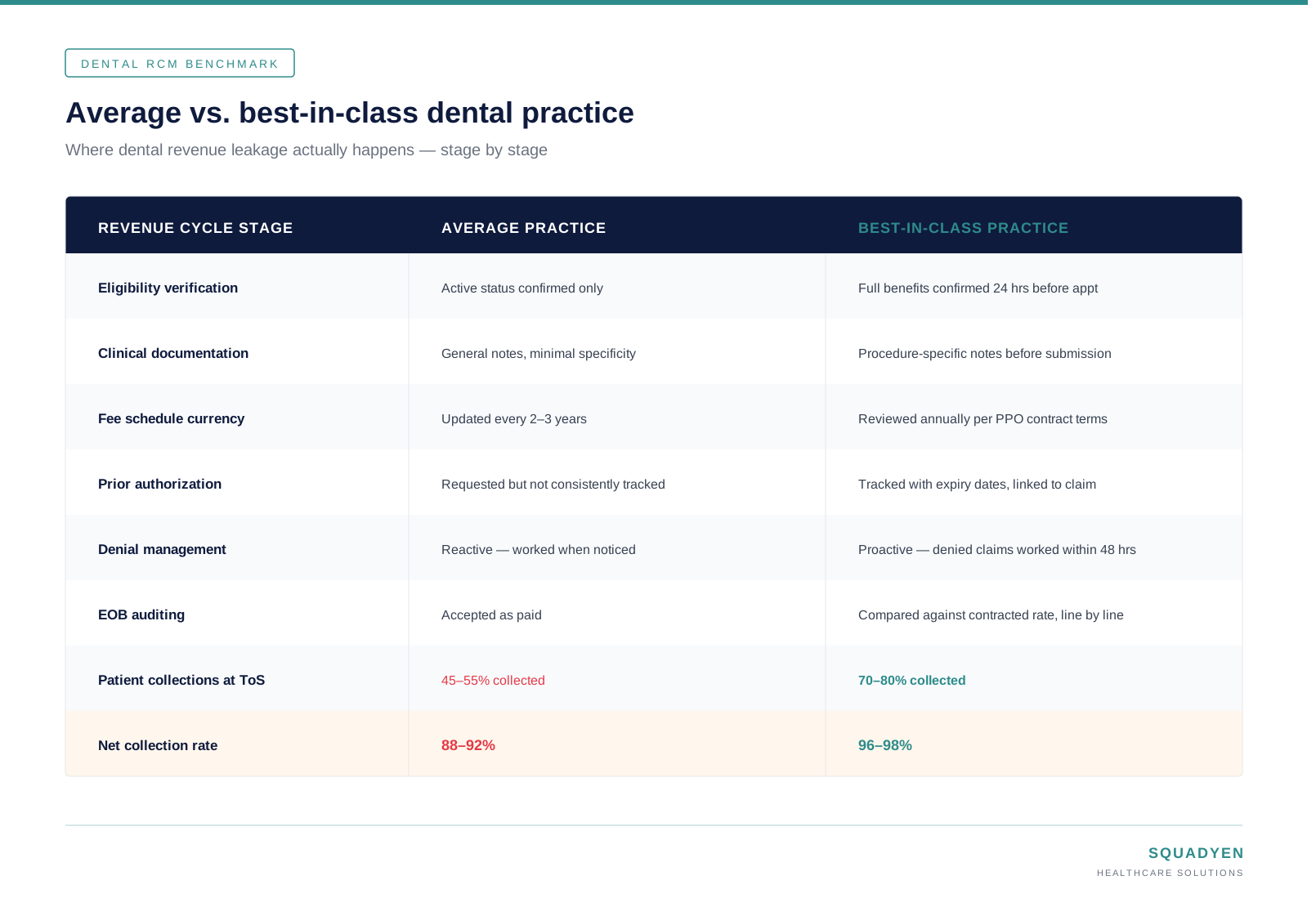
Best-in-class dental practices collect 70–80% of patient responsibility at time of service. The industry average is closer to 45–55%. That gap — 20–35% of patient balances that leave the office unpaid — represents a collections challenge that compounds monthly.
The primary driver is not patient unwillingness to pay. It is friction: patients who didn’t understand their financial responsibility before treatment, practices that send one paper statement and nothing else, and patient portions that are incorrectly calculated because eligibility verification was incomplete.
10 Questions to Spot Dental Revenue Leakage in Your Practice
Answer these questions to estimate where your practice stands on dental revenue leakage:
- Does your team verify specific benefits — not just active coverage — for every patient before their appointment?
- Are your PPO fee schedules reviewed and updated annually for every payer?
- Does your clinical documentation include procedure-specific detail (surfaces, depth, treatment necessity) before claims are submitted?
- Do you have a tracking system for prior authorisation approvals, expiry dates, and linkage to claims?
- Are secondary claims filed within 24 hours of receiving the primary EOB for dual-coverage patients?
- Does your team audit paid claims against contracted fee schedules to identify underpayments?
- What percentage of patient responsibility is collected at time of service? Do you know this number?
- Is your denial rate tracked monthly by denial reason code and payer?
- What happens to a claim after its first denial? Is there a defined protocol with a 48-hour resubmission target?
- Are write-offs categorised by type (contractual, bad debt, billing error, sliding fee) so you can identify which are avoidable? A ‘no’ answer to any of the first five questions indicates a front-end leakage problem.
A ‘no’ to questions six through ten indicates a back-end revenue recovery problem. Most practices have both.
Best-in-Class vs Average: A Side-by-Side Comparison
Frequently Asked Questions
Q: How do I calculate my practice’s revenue leakage rate?
Start with your net collection rate — total payments received divided by total collectible charges (gross charges minus contractual adjustments). Subtract from 100%. If your net collection rate is 88%, your leakage rate is 12%. Next, break that 12% into categories: denials, write-offs, patient balances, and underpayments. Each category points to a different process fix.
Q: Is 15–20% revenue leakage normal for dental practices?
It is common, but it is not unavoidable. Industry benchmarks show that best-in-class dental practices run net collection rates of 96–98%, while the average sits at 88–92%. The 8–10 percentage point gap represents preventable losses from front-end failures, unworked denials, and inadequate patient collection processes.
Q: What is the fastest fix for dental revenue leakage?
The fastest lever is eligibility verification — specifically, moving from active-status confirmation to full benefits verification before every appointment. This single change reduces denials, improves patient financial conversations, and eliminates a significant category of claim rejections. It typically produces measurable improvement within 30 days.
Find Out Where Your Practice Is Losing Revenue
Book your free assessment → squadyenhealth.com/contact/
Squadyen offers a complimentary 30-minute revenue cycle assessment for dental practices. We review your key metrics — net collection rate, denial rate, AR aging, and write-off categorisation — and identify the top three revenue leakage points in your cycle.