
Should I outsource Dental billing? If you have searched for this answer, you are probably not looking for a list of reasons why outsourcing is great. You already know the pitch. You have probably received it from at least three vendors.
What you actually need is a clear-eyed framework to evaluate whether outsourcing makes sense for your specific practice — right now. Not a universal answer. Not a sales case. A decision framework you can apply in the next 20 minutes.
That is what this guide is. It includes the honest case for keeping billing in-house, the real cost calculation most practice owners skip, a diagnostic checklist of signals that suggest a change is worth evaluating, and a practical guide to choosing the right vendor if you decide to move forward.
The Honest Case for Keeping Billing In-House
In-house billing works well — genuinely well — when certain conditions are true. Before evaluating outsourcing, be honest about whether your practice meets all of these:
- Your billing person’s only job is billing. They do not manage the front desk, answer phones, schedule appointments, or handle insurance calls during check-in.
- Your denial rate is consistently below 6%. (If you do not know this number, that itself is a signal.)
- Your net collection rate is consistently above 95%. (If you do not know this number either, we will come back to that.)
- Your AR over 90 days represents less than 12% of total outstanding AR.
- You have a documented backup plan for billing continuity when your biller is on leave or resigns.
- Your practice owner or manager reviews billing metrics monthly — not just total collections.
If every one of these is true, in-house billing is working. Outsourcing would be a disruption to something that doesn’t need disrupting.
If two or more are not true, the cost-benefit calculation changes.
The Real Cost of In-House Billing (Most Practices Underestimate This)
The most common argument against outsourcing is cost: ‘I already pay my biller. Outsourcing would cost more.’ This calculation is almost always wrong — because it only counts the salary.
The true all-in cost of an in-house biller for a typical dental practice:
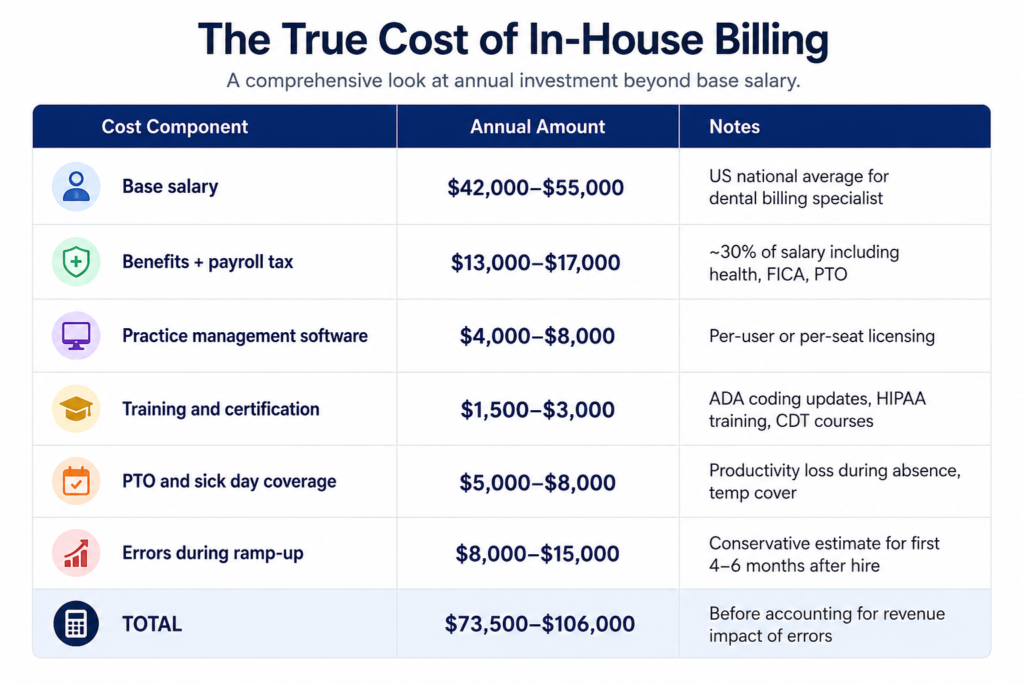
This is the cost when billing is going well. When the biller leaves — which happens at a 28–35% annual turnover rate in dental billing roles — add $8,000–$12,000 for recruitment and another 4–6 months of elevated error rates during the ramp-up of the next hire.
5 Signals That Suggest Outsourcing Is Worth Evaluating
Signal 1: Your Denial Rate Is Above 8%
A denial rate above 8% almost always indicates a systemic process problem — not an occasional error. At this level, the volume of rework, the staff time consumed by resubmissions, and the revenue lost to timely filing violations begin to exceed the productivity of in-house billing. An experienced outsourced team typically brings denial rates below 5% within 60–90 days.
Signal 2: Your 90+ Day AR Is Growing
If your 90+ day AR bucket is growing month over month, your billing operation is not keeping pace with the follow-up volume. This is one of the most common and most expensive signals — because every month that passes reduces the collection probability on those accounts.
Signal 3: Your Biller Also Has Another Role
When your biller is also managing front desk operations, insurance calls, and scheduling, billing becomes a secondary task. Secondary tasks produce secondary results. A person doing two jobs cannot give either job the focused attention it requires — and in dental billing, the cost of divided attention shows up directly in your collection rate.
Signal 4: You Do Not Know Your Net Collection Rate
If you cannot state your practice’s net collection rate from memory — not the gross collection rate, not total collections, but the net collection rate — that is a signal that billing performance is not being measured or managed. An outsourced team with proper reporting will give you this number and several others, monthly, without being asked.
Signal 5: You Spent Time This Month Thinking About Billing
As a practice owner, your highest-value activity is clinical care and strategic decision-making. Every hour you spend thinking about why a claim was denied, why your collections dropped, or why your biller hasn’t followed up on a disputed account is an hour not spent on what you do best. If billing is regularly taking your mental energy, that is a signal.
What Outsourcing Actually Looks Like Day-to-Day
The most common concern about outsourcing is loss of control. In practice, the opposite tends to happen — well-run outsourced billing operations provide more visibility, not less.
What changes when you outsource to a professional dental RCM team:
- Claims are submitted the same day or next business day after treatment documentation is finalised
- Denials are worked within 48 hours — not when someone gets to them
- You receive a monthly performance report showing net collection rate, denial rate, AR aging distribution, and collections trend — automatically
- When your biller takes leave or resigns, your billing does not stop. Continuity is built into the model.
- Payer-specific expertise improves over time — the team accumulates knowledge about your specific payer mix that would take an in-house biller years to develop
What does not change: you retain full visibility into every claim, every payment, and every patient account. You can see everything. You just do not have to manage everything.
How to Evaluate a Dental RCM Vendor Without Getting Sold
If you decide to get quotes from outsourced billing vendors, here are the eight questions that separate genuine expertise from a sales pitch:
- What is your current average dental claim denial rate across your active clients?
- What is your average net collection rate across dental practices you serve?
- How do you handle same-day treatment and claim submission?
- What practice management software are you experienced with — specifically with my system?
- What does your onboarding process look like, and what are my responsibilities during the transition?
- Who is my account manager, and how quickly can I reach them when something is wrong?
- Can I speak with two or three current dental practice clients as references?
- What does your monthly reporting look like — can you show me an example?
Three red flags that should end the conversation:
- Vague answers about performance metrics (‘we focus on quality’) without specific numbers
- Resistance to providing client references before signing
- A contract with a 12+ month lock-in and limited exit provisions
The ROI Calculation: What a 5% Collection Rate Improvement Is Worth
Example: Practice producing $1.4M annually, current net collection rate 91%, considering outsourcing at 6% of collections.
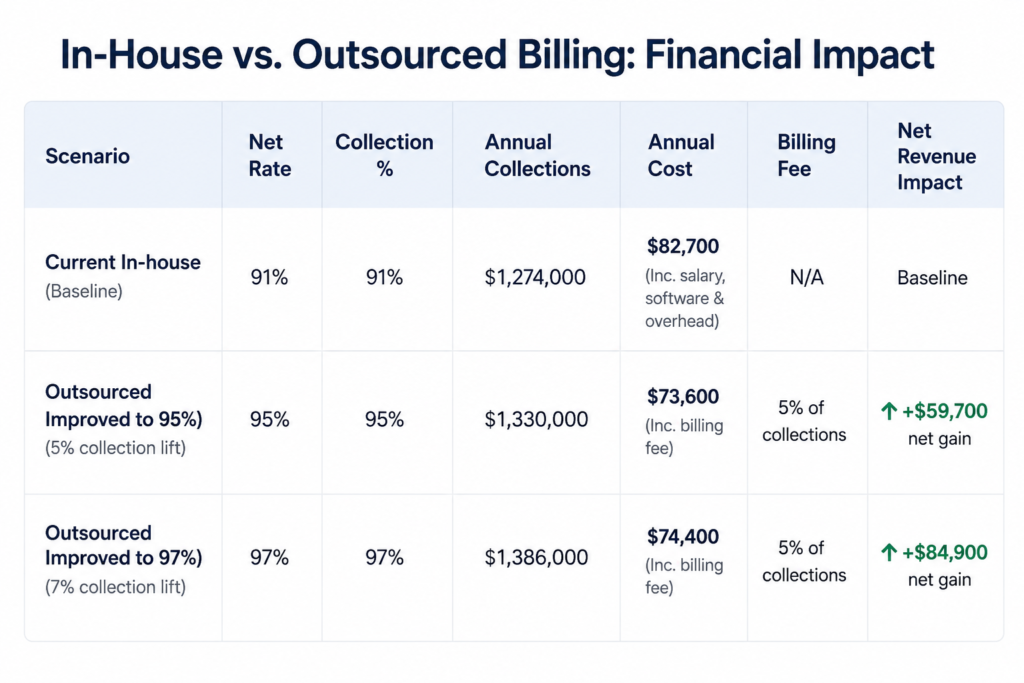
The calculation is not about the billing cost — it is about the collection rate improvement. A 4–6% net collection rate improvement, which is achievable in 60–90 days with a competent outsourced team, typically returns 5–10x the cost of the outsourcing fee in additional revenue.
Decision Matrix: Should You Outsource?
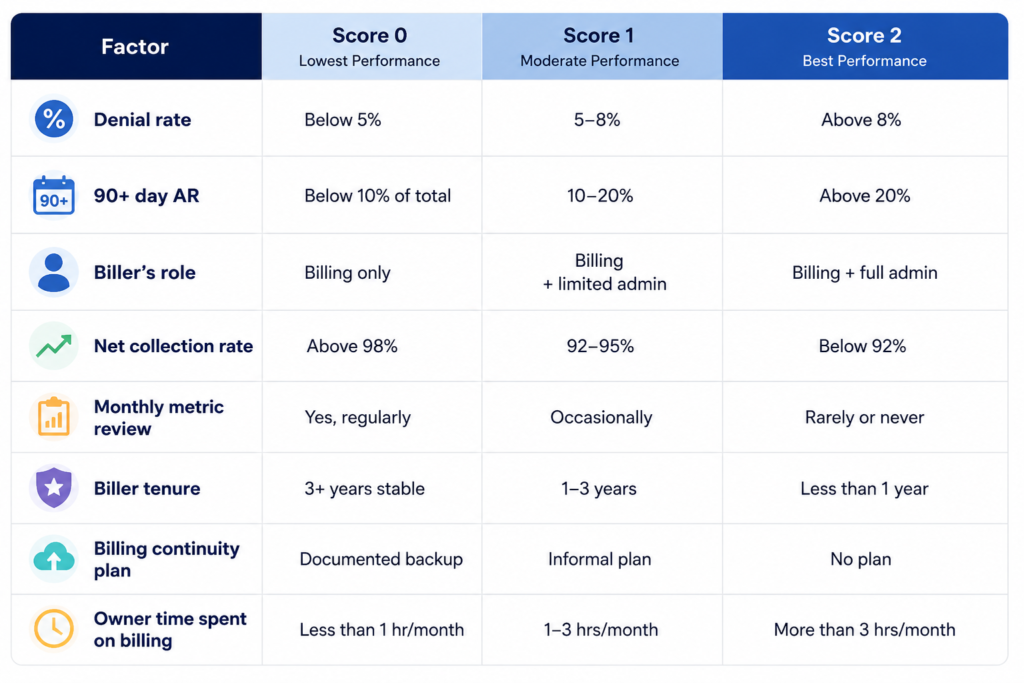
Score your practice on each factor. If your total score is 8 or above, outsourcing is worth a serious evaluation.
Frequently Asked Questions
Q: How long does it take to transition to outsourced dental billing?
A well-managed transition typically takes 2–4 weeks from contract signing to full operation. The first two weeks involve system access, workflow mapping, and data migration. Most practices see their first claims submitted by the outsourced team within 10 business days. Some practices choose to run parallel operations for the first month — in-house and outsourced simultaneously — before fully transitioning.
Q: What percentage of collections do dental billing companies typically charge?
Most dental RCM companies charge between 4% and 9% of monthly collections, depending on practice size, specialty mix, and scope of services. Larger practices with higher volume typically negotiate toward the lower end of the range. Some vendors also offer flat monthly fee models, which can be advantageous for practices with predictable revenue.
Q: Will I lose control of my billing if I outsource?
No — with a well-structured partnership, you gain more visibility, not less. A professional outsourced team should provide monthly performance reporting, give you access to the same practice management system you currently use, and have a named account manager you can reach directly. You delegate the execution; you retain the oversight.
Talk to Squadyen — No Pitch, Just a 30-Minute Review. Not sure whether outsourcing is right for your dental practice? Squadyen offers a straightforward 30-minute conversation — we look at your current metrics, give you an honest assessment, and tell you whether we think a change would help. No pressure. No long proposals.