
A claim that crosses 90 days without payment isn’t just late. Statistically, its probability of full collection drops below 50%. At 120 days, that figure falls below 25%. At 180 days, most claims in this category will be written off.
The painful reality for most dental practices is that their 90+ day AR bucket contains a significant portion of fully collectible revenue — claims that could and should have been paid — that were simply not followed up on with the urgency they required.
This article explains why dental AR ages, what a healthy AR profile looks like, and how to recover what’s sitting in your aging buckets right now.
What AR Aging Actually Tells You
An accounts receivable aging report sorts outstanding claims and balances by how long they have been unpaid. The standard buckets are 0–30 days, 31–60 days, 61–90 days, and 90+ days. Most practices know these buckets exist. Far fewer use them diagnostically.
The age distribution of your AR is not just a collections snapshot — it is a diagnostic map of where your revenue cycle is failing:
- A large 0–30 day balance is normal. Most claims are in transit and will pay on schedule.
- A large 31–60 day balance often indicates payer processing delays or claims that require status follow-up.
- A growing 61–90 day balance is a warning signal — these claims have already missed one follow-up cycle and are approaching denial or timely filing risk.
- A large 90+ day balance is a crisis indicator. It means systematic follow-up failure — not just slow payers.
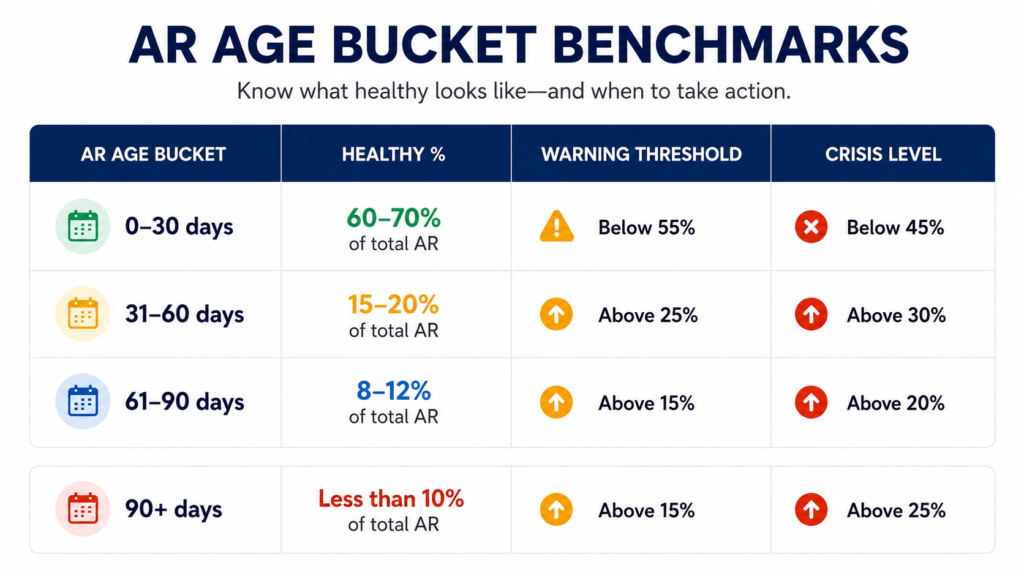
AR Benchmarks for Dental Practices
The 5 Reasons Dental AR Ages
Reason 1: Denied Claims Not Reworked Within the Payer Window
When a claim is denied, it enters the denial queue. In many practices, this queue is worked inconsistently — high-value claims get attention, lower-value claims sit. Over weeks, those lower-value claims cross into the 60, then 90-day bucket. Some cross the timely filing limit and become unrecoverable.
The fix is a non-negotiable 48-hour denial rework rule. Every denied claim gets a next action assigned within two business days — not eventually, not when there’s time.
Reason 2: Secondary Claims Never Filed After Primary EOB
For patients with dual coverage, the primary claim is filed and paid. The primary EOB arrives. And then — in a significant number of practices — the secondary claim is never filed. The balance sits as patient responsibility in the practice management system, ages through the buckets, and is eventually written off or sent to collections.
Secondary claim filing must be triggered automatically when the primary EOB posts — not as a manual task that depends on someone remembering.
Reason 3: Incorrect Payer Information Causing Mail Returns or Portal Rejections
Claims submitted to an incorrect payer address, an outdated payer ID, or a deprecated submission route will be rejected or simply not received. If the practice management system doesn’t flag the rejection, the claim sits as ‘submitted’ in the system while actually sitting nowhere. 45 days later, the billing team may not realise the claim was never received.
Reason 4: Patient Balance Follow-Up Consisting of a Single Statement
Patient AR ages for a different reason than insurance AR. Patients who owe a balance after insurance processes typically receive one paper statement. If they don’t pay, nothing else happens until the practice’s billing person has time — which may be 60 days later.
A minimum three-touch follow-up sequence — statement at day 10, text reminder at day 25, phone call at day 40 — increases patient balance collection rates dramatically and keeps patient AR out of the 90+ bucket.
Reason 5: No Escalation Protocol for Payer Non-Response
Some payers are slow by design. Status calls go to queues. Portal inquiries produce automated responses. When a billing team member’s follow-up produces no result, many practices simply wait — and wait — and wait. The claim ages without anyone escalating to a supervisor at the payer, filing a formal complaint, or initiating a redetermination request.
What an Action-Oriented AR Report Looks Like
Most dental practices have an AR report. Very few have an AR action system. The difference is this: an AR report records the history of a claim. An AR action system tells someone what to do today.
An action-oriented AR workflow assigns ownership and a next action date to every account:
- 0–30 days: Automated tracking. No manual action required unless the claim is rejected.
- 31–60 days: First follow-up. Status check via portal or phone. Note the status in the system. Assign next follow-up date.
- 61–90 days: Second follow-up. Escalate to supervisor at payer if initial inquiry produced no result. Review claim for errors that may be causing silent rejection.
- 91–120 days: Formal appeal or corrected claim submission. Redetermination request if prior appeals were denied.
- 120+ days: Management review. Document the claim history. Make an explicit write-off or continue-pursuit decision — never let it drift.
Every account in the 90+ bucket needs a next action and a next action date. If it doesn’t have one, it is not being managed — it is being recorded.
A 30-Day AR Recovery Sprint
If your 90+ bucket is significantly above benchmark, here is how to work through it systematically in 30 days without pulling your billing team off current claims:
- Week 1: Pull all claims aged 90–120 days. Sort by dollar value. Identify the top 20% by value — these typically represent 80% of recoverable revenue. Assign each to a team member with a 5-business-day follow-up deadline.
- Week 2: Work the 120–180 day bucket using the same prioritisation. For any claim where the denial reason is still unclear, call the payer directly. Do not rely on portal responses for accounts at this age.
- Week 3: Address the patient balance component of the 90+ bucket. For every patient balance over $200, initiate a direct phone call — not a statement. Ask the patient whether they received their bill and whether they have any questions. Many will pay immediately.
- Week 4: Review all accounts that were reviewed in weeks 1–3. Close out any that have been resolved. Make final disposition decisions on any remaining accounts — document the rationale for every write-off.
Frequently Asked Questions
Q: What percentage of dental AR should be over 90 days?
Best-in-class dental practices keep their 90+ day AR below 10% of total outstanding AR. Above 15% is a warning level. Above 20–25% indicates systematic follow-up failure and significant unrecovered revenue sitting in aging accounts.
Q: How do I recover revenue from dental AR that’s already over 120 days old?
Start with a payer call on every account over $500 in value. For insurance claims, ask for the current status and whether additional documentation is required. For patient balances, initiate direct phone contact rather than sending another statement. In many cases, AR that appears uncollectable simply hasn’t been actively followed up on. Recovery rates of 40–60% on 90–120 day AR are achievable with structured follow-up.
Q: What is the right AR days target for a dental practice?
The target for dental practices is typically 25–35 days in AR. This measures the average number of days between service and payment across all outstanding accounts. Above 40 days indicates the AR cycle is slower than it should be. Above 50 days suggests a systemic issue in either claims submission speed or follow-up cadence.
Find Out How Much Revenue Is Recoverable in Your Aging AR. Squadyen provides a 30-minute AR audit for dental practices — identifying what is sitting in your 90+ bucket, what is genuinely recoverable, and what a 30-day recovery sprint would look like for your practice. Request your AR audit now!